
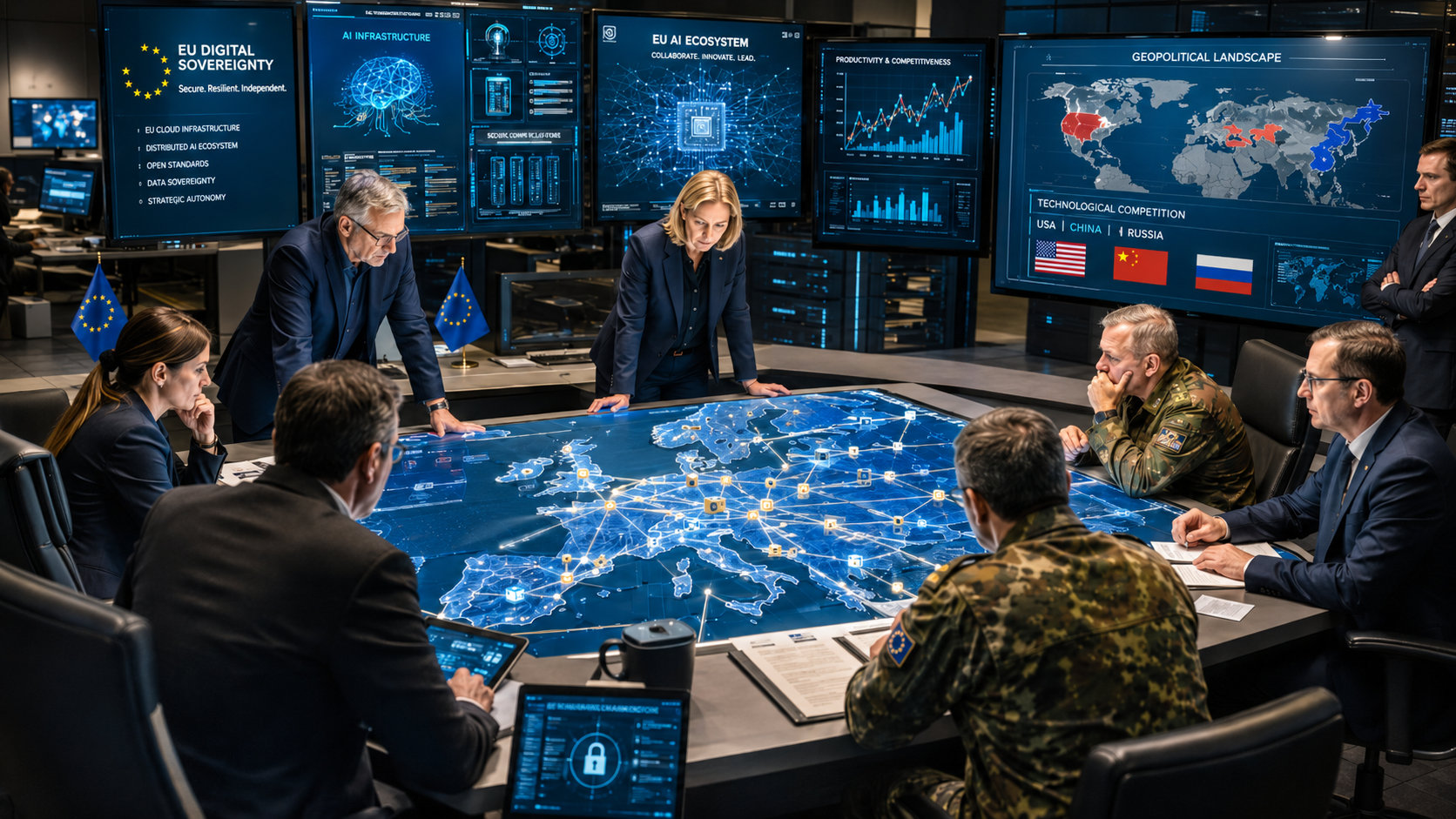
An Argument for the EU’s Digital Sovereignty
Digital sovereignty is the ability of a political community to control the infrastructure, data, computing capacity, models, legal conditions, and operational decisions on which its essential digital functions depend.Update, 1 July 2026 — In the interim, Chinese researchers (Z.ai) released GLM 5.2, a model that marks a significant advance in open-source AI and substantially narrows the performance gap between leading U.S. frontier models and their open-source counterparts, while also delivering considerable reductions in inference cost.
On 9 June 2026, Anthropic introduced Claude Fable 5 and Claude Mythos 5. Three days later, Anthropic announced that it would suspend access after receiving a U.S. government directive restricting the models’ availability to foreign nationals.
Anthropic did not do so on a whim – it was forced by the U.S. government. Citing national security concerns, the government instructed Anthropic to prevent any user who was a foreign national from using it, including foreign-national Anthropic employees and foreign-national employees of U.S. companies. Faced with the practical and legal difficulty of determining who qualified as a pure-bred American and who did not, Anthropic chose to disable access for everyone, indiscriminately disabling access to both models.
During the brief period in which I used Fable 5, I found its performance on complex coding tasks noticeably stronger for this class than that of the models I had previously used. (this is a personal assessment; ymmv)
Would this “smartness” make it dangerous? I would argue not, but that is not the crux of the problem: eventually, other models will match and then surpass its abilities.
The problem is that the U.S. government decided to lock the models away from everyone else.
AI has proven itself to be a highly useful and versatile tool that will have a significant impact on society and probably on our civilization as well. It will do so in two ways:
It will increase productivity in many areas.
It will make warfare much more dangerous.
I am not going to dwell on increased productivity, because the early figures already demonstrate the importance of having access to such digital assistants; nor am I going to lament their horrifying effectiveness at taking human lives, which has already been demonstrated on the battlefield.
Let us focus on a cold, hard fact: countries with access to capable AI models will have a significant, perhaps insurmountable advantage over countries that lack the same resource. They will be more productive in creating new value, inventing new things, and improving existing ones; in warfare, they they may reduce casualties on their own side while increasing their lethality by orders of magnitude.
AI technology, therefore, should be treated as a strategic resource vital to the existence of a state. The EU should never allow itself to depend on an unreliable ally that might simply cut off access to a frontier model – the most advanced kind of model available at a given time – if the EU rejects that ally’s geopolitical demands, or that might turn against it on a whim. Therefore, the EU has no choice but to focus on developing its own capable AI infrastructure and models under its full control.
The EU is lagging in this respect, with even its best models and already established infrastructure still significantly behind those of powerhouses such as the U.S. and China, which have the resources, manpower, and strategic insight to pursue this technology aggressively. There is a great deal of catching up to do, but ultimately, there is no escaping that necessity.
The EU’s perceived weaknesses might turn out to be a blessing in disguise. As data centres are now prime targets in kinetic warfare, EU member states might decide to develop decentralized, distributed clusters of protected data centres that could, in the true spirit of the early internet, survive significant damage to individual nodes. By striking a compromise between sheer power and redundancy, the EU should be able to create infrastructure capable of competing with the major players. Models trained on this infrastructure could be distributed to individual countries to serve as local inference centres. The computing clusters could also be interconnected to provide somewhat slower but still massively capable computing power.
This would be an architecture designed for an uncertain future, in which allies could become enemies overnight and external pressures could create new challenges requiring new and smarter solutions. We should build not only to overcome an enemy in war but also to endure the difficult times ahead. Just as returning to cavalry will not win a modern war, falling behind in technological progress will not make our economy stronger or more competitive.
A sovereign European AI architecture should include:

1. geographically distributed training and inference;
2. protected data centres;
3. European-controlled model weights or enforceable access rights;
4. open standards and model portability;
5. sovereign identity and access management;
6. independent energy and semiconductor planning;
7. civilian and defence redundancy;
8. transparent governance and auditing.
Views: 61
Comments, rants and vents